The Neuroscience of Fight, Flight, or Freeze
The loud, guttural growl of a lion shredded the stillness ahead. A sound that bypassed thinking to fuse directly with my nervous system.
I halted mid-stride on the game path and raised my left fist—the prearranged signal for the six guests walking single file behind me to “Stop dead where you are. Don’t move. Don’t make sound.”
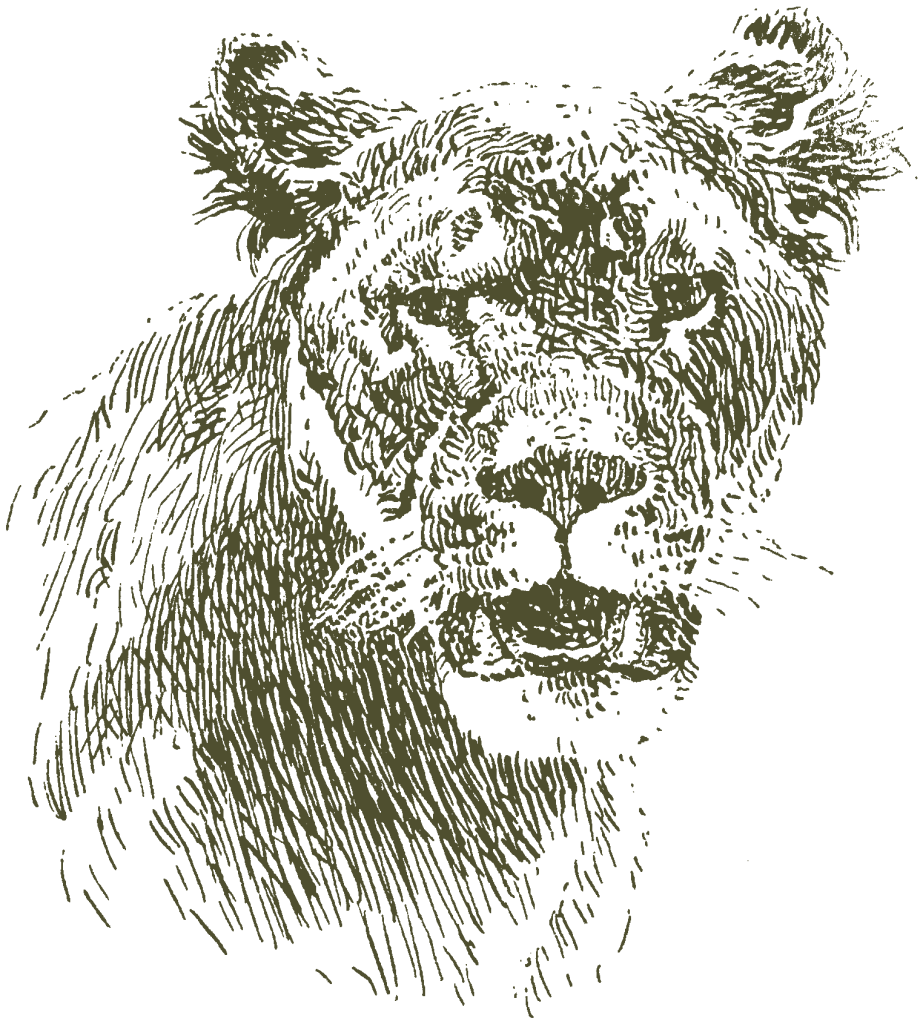
Lioness.
A dozen metres ahead, crouched low in the grass at the base of a granite kopje we were heading for. Ears flattened. Tail thrashing. Yellow eyes burning into mine with chilling hostility. Glancing briefly at the wide-eyed group behind me, I noticed David at the back scurrying to catch up—against explicit instructions—only stopping when he caught my glare.
Eyes front.
My brain’s pattern recognition was instant and automatic, built by years on foot in dangerous-game country.
“Angry lioness. Not retreating. Probably cubs up the kopje. Brave mother.”
Slowly, I lowered my arm to grip the rifle with both hands.
“Snarling. Tail lashing side to side in warning—normally. Not the vertical whip before a serious attack—usually. Never presume. Brace yourself.”
She rose, started forward, then launched herself with a loud grunt—150 kilograms of muscle exploding towards us in a furious bounding yellow blur.
One Lioness. Three Human Brain Constructions
The moment she charged, three people experienced three fundamentally different realities.
Not three interpretations of the same event, but three distinct experiences, each actively constructed by three brains making different predictions about what was happening and what to do about it.
Modern neuroscience1 shows that emotions are not universally-shared responses governed by hardwired fear circuits or triggered by inherited instinct. The brain is a prediction machine, continuously generating best-guess models from previous experiences, and current context about what sensory input means for the body. The senses refine prediction—they don’t create emotion.
The old Triune Brain myth tells us that the primitive “reptilian brain” instinctively reacts to extreme threat by “hijacking” the mammalian “emotional brain” to overwhelm the prefrontal cortex of the “rational brain.”
That model has been thoroughly debunked.2 There are no separately evolved rational, emotional and instinctive brains fighting for control. There is one integrated, predictive network system working to keep you alive with the accumulated data it has.
Crucially, these predictions operate within certain thresholds where arousal, perception and action remain flexible. Beyond them, systems reorganise, locking in less options.
This is as true of natural ecosystems as it is of brains.
In resilience science, a threshold is the point at which a system shifts—often abruptly and negatively—into a different state of being. A mixed woodland becomes bush-encroached shrubland. A savannah becomes desert. A nervous system tips from mobilisation into panic or paralysis.
Same stimulus. Different thresholds crossed.
My Construction: FIGHT the Manageable Threat
I cocked my .500 NE double rifle as it came up, butt unconsciously slotting into my shoulder, clear sight picture and finger on the front trigger. Roaring at the group to “Stand still!” and at the lioness to draw her focus onto me, steeling my nerves in a mixture of fear, projected bravado, and deterrence.
None of this was conscious deliberation. It was a prediction model built over decades of walking safari experience, weapons drill and shooting. Reinforced by repetition, feedback, and command & control responsibility under combat stress.
My hypothalamus triggered a massive sympathetic nervous system cascade. Heart rate doubled from 70 to 140. Blood pressure spiked. Adrenaline flooded my bloodstream.
Crucially, my system did not breach its threshold. Fear increased without fragmenting coordination and my brain remained functionally engaged with feedback categorising the extreme arousal not as panic, but as preparation.
Each previous encounter with danger that ended in successful regulation had reinforced a stabilising loop: high arousal → coherent action → survival → updated prediction that arousal is survivable.
“Here she comes. I’ve been here before. Stand your ground. Fight. Shout. Assess her intent. I know my rifle. I know my shooting ability. Aim centre.”
My pupils dilated for more light, yet my visual field narrowed to a tunnel—not because my peripheral vision failed, but because my brain allocated all processes to the threat. Time seemed to slow down, forming crystal clear focus of her shape, speed, line, posture and purpose.
This is ecological resilience in neural form.
Skid-bouncing stiff-legged to a grunting halt about five metres in front of me, scattering dirt and dust, she spun round, ran back, turned snarling to face us again.
This wasn’t over.
Sarah’s Construction: FLIGHT from Catastrophic Danger
Sarah experienced the same sensory input—but crossed a different threshold.
Her heart rate surged higher than mine. Her nervous system prepared for flight. Blood flow primed her legs for escape. Her brain retrieved its best available predictions: “Lions kill people. Distance equals safety. Predator means RUN!”
These weren’t irrational. They were the only models she had. No prior experience managing threats at this scale. No embodied memory of standing firm and surviving. Her brain constructed the arousal as catastrophic
Her prefrontal regulatory networks struggled under the neurochemical load—not due to weakness, but because they had never been trained to operate there.
As arousal climbed, regulatory networks lost traction. Competing signals flooded her system. The threshold into catastrophic meaning-making was crossed—a threshold where adaptive stress transforms into system overload.
Beyond this point, feedback loops became reinforcing rather than stabilising: fear amplified fear; sensation confirmed danger; danger confirmed disaster.
Only external regulation—my voice shouting “Stand still! Hold each other!” and her partner gripping her—prevented her from bolting.
David’s Construction: FREEZE in System Shutdown
David’s nervous system crossed yet another threshold to construct a third reality.
His nervous system surged into high arousal, but instead of mobilising movement, it suppressed it. This is the freeze response. Not calm, not low arousal, but intense activation paired with motor inhibition.
Freeze occurs when the brain predicts that action will worsen outcomes. Movement feels impossible, not because the person “chooses” paralysis, but because the system has concluded that any action is unsafe.
David’s muscles locked, halting movement. His attention narrowed inward. As the charge neared, dissociation crept in—perceptual distance, unreality, emotional blunting. This was not a full tonic immobility collapse, but a freeze-dominant state with emerging dissociative protection.
This response serves a short-term function: it reduces metabolic load and psychological overwhelm when no viable action is perceived. But it carries long-term risk because high arousal without acting fragments memory encoding and increases vulnerability to post-traumatic stress.
Importantly, freeze is not cowardice. It is what happens when a nervous system has no trained prediction for effective action.
Four Charges. Three Diverging Feedback Loops
She charged again. And again. And again.
Each time, my predictions updated. By the third charge, the pattern was confirmed.
“Protective defence. Not malicious aggression. Typical. Stand when she comes. Back off when she does. Control the Guests.”
My fear remained constant. But it became familiar, structured, even useful in a stabilising feedback loop where each charge refined and reinforced my predictions rather than destabilising them: arousal → action → outcome → confirmation of warning charges.
Sarah’s regulatory capacity eroded with each charge. Every time reinforced “This is how I die,” rather than “This is the lion’s pattern” in a different loop of: arousal → terror → confirmation of catastrophe.
David sank deeper into freeze. Each charge confirmed pure helplessness. His brain constructed that nothing he did mattered. It was all useless—the feedback drove him over his threshold.
Same lioness. Same charges. Three constructed realities.
This is precisely how social–ecological systems behave under repeated stress.
What This Reveals
These four charges weren’t just a terrifying lesson in neuroscience, but in resilience science.
They were a demonstration of how living systems—from brains to savannahs—respond to extreme uncertainty.
Resilience is not resistance to disturbance. It is the capacity to absorb disturbance without crossing critical thresholds that collapse function. Not the absence of fear—the ability to construct fear as functional.
Without training, exposure, and graded stress, nervous systems flip state when thresholds are breached.
We don’t “rise to the occasion”—we fall back on the predictions our systems have learned.
Resilience is learnable and trainable, and modern cognitive & behavioural therapies can change how your brain constructs experience by feeding it new data, new patterns, new predictions to work with.
Philosophy of Resilience
The founders3 of this field of psychotherapy were directly inspired by the ancient Greek and Roman Stoic philosophers4 who were training resilience over 2,300 years ago without understanding the neuroscience behind it.
The Stoics framed this as living in accord with Nature—both universal Nature and human nature.
They taught exposure, regulation, and perspective to keep the human psyche within functional bounds under pressure.
Today, neuroscience and ecology reveal why it worked.
Nature has been refining resilience for 3.8 billion years. Our nervous systems are one expression of those same principles.
Next week, resilience science shows what ecology teaches us about threshold tipping points, feedback loops, and the fragile space where resilience is either strengthened or lost—and what that means for the human psyche.
References
- ‘The theory of constructed emotion: an active inference account of interoception and categorization’, Lisa Feldman Barrett, 2017.
- Hodos & Campbell, 1969.
- Albert Ellis (1913-2007): Rational Emotional Behavior Therapy. (REBT); Aaron Beck (1921-2021): Cognitive Therapy.
- Seneca (4-65 CE), Epictetus (50-135 CE), Emperor Marcus Aurelius (121-180 CE).
Leave a Reply